


Craft Your Own Twisted Tunisian Cloth Using this Free Tunisian Crochet Pattern

Updated: Jul 1

Why use the Twisted Tunisian Cloth Free Tunisian Crochet Pattern?
A dense absorbent and textured cloth which is really relaxing to make. It makes a great mat too and can be made any size by adding however many stitches or rows you want!
If you prefer using a downloadable or printable pattern rather than working from patterns on websites, this pattern is also available to purchase as a printable pdf on Ravelry
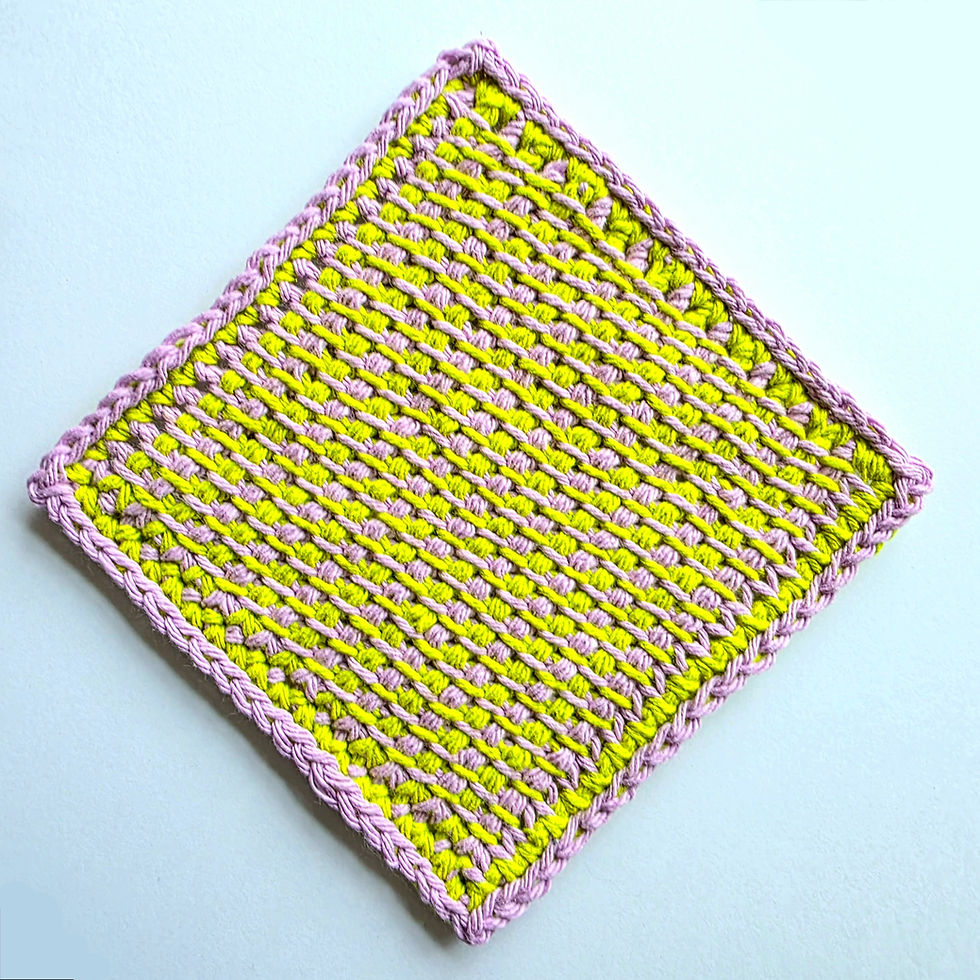
The interesting texture of this stitch is created by working through the stitch in the row below in the opposite direction to standard Tunisian simple stitch. I enjoy working this stitch variation between other projects that involve a repetitive stitch to switch up the way my hands and arms move.

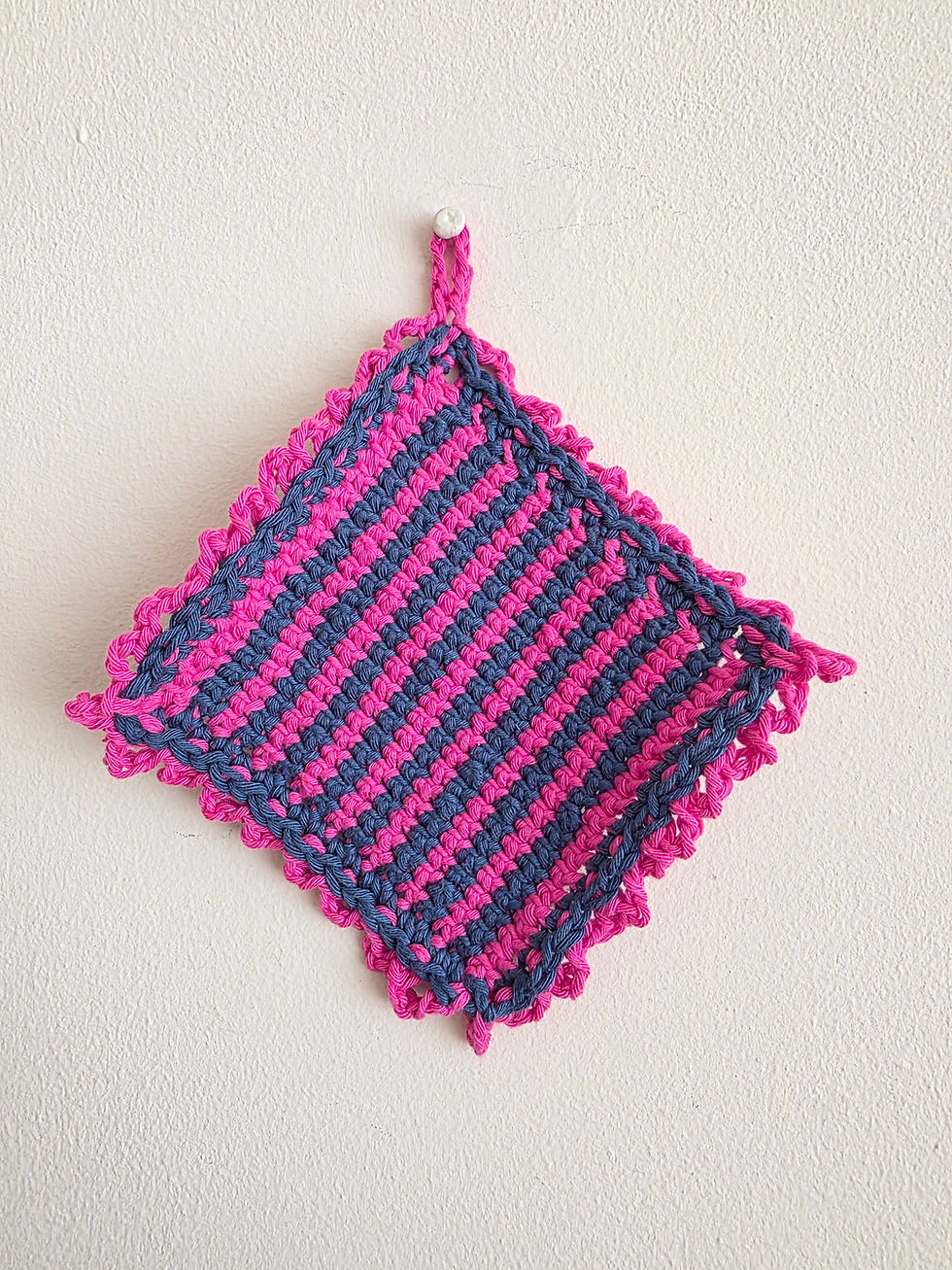
Enhance this textured stitch with a pair of bold contrast colours to brighten up your home décor, perhaps matching the season or occasion or use similar shades for a subtle almost tweedy effect.
Enjoy making your cloth!
A Gift for You
If you love making washcloths, did you know that I'm publishing a FREE washcloth pattern every month in 2026? Join my mailing list on this sign up page to get notified when each one is ready to make and you'll also get a copy of my sign-up gift, "The Yarncrafter’s Guide to Creating Sturdy Bags", a workbook with lots of tips, experiments and tests for yarns, tools, stitches etc. to help find the best ones for projects that would benefit from being more sturdy, whether that's a bag, a storage basket or a garment that needs to keep crisp lines or avoid sagging.
Join the 2026 Washcloth Make along

The Twisted Tunisian Cloth Free Crochet Pattern is part of a series of monthly washcloth patterns released throughout 2026. I was so pleased with how popular my Endearment Washcloth was when it launched in January, that I decided I should make a washcloth pattern each month available free on my website in both UK and US terminology plus with a full video for the pattern so as many people as possible can make it.
Twisted Tunisian Cloth: Free Crochet Pattern
Sizes: One size with adjustment tips at end.
Tension: 16 sts x 14 rows = 10cm x 10cm / 4” x 4” measured over Twisted Tunisian Simple Stitch
Working method: Centre is worked bottom up. Piece is edged in the round.
Finished measurements (see schematic)
a. Length: 15cm / 6”
b. Width: 15cm / 6”
Requirements

Drops Paris aran/worsted weight: 75m (82 yd) per 50g skein; 100% cotton or similar (Sample worked in C1 Cerise 06 and C2 White 16)
C1: 20 m/22 yd
C2: 20 m/22 yd
6mm / US J/10 straight shaft crochet hook
Yarn needle and scissors
Abbreviations and Special Stitches
st/sts stitch/stitches
R Row/s or round/s
RS/WS right/wrong side
ch chain (0)
rep repeat
slst slip stitch (.)
dc double crochet (x)
twTss Twisted Tunisian simple stitch
chsp chain space
RetP: Draw yarn loop through 1 loop, draw yarn loop through 2 loops on hook to end.
P3 3 ch, slst in 3rd ch from hook
Pattern Notes
Beginning/turning chains count as a stitch unless otherwise specified in pattern instructions.
You may like to bring the new colour for each row through on the last st of the previous row for neat edges.
A hook with a very pointy tooth is ideal for working this stitch.
This pattern is available in both UK terminology and US terminology. The only differences are in Edging R1. Please be sure you follow the directions for this round in your preferred terminology.
I recommend that you read through the pattern before starting.
Method

CENTRE
Worked flat in rows each consisting of a forward and a return pass.
With C1, 20 ch.
R1: Pull up loop in 2nd ch from hook and each ch to end, work, RetP. 20 loops/st inc. original loop on hook.
R2: Join other colour, twTss to end, RetP.
Rep R2 15 more times alternating colours for each row.
Do not fasten off.
EDGING
Notes: R1 is provided in both UK crochet terms and US crochet terms. Follow your preferred version of R1 once and then work R2, which is the same for both crochet terms. For R1 (side 1) work all sts through the front loops in same direction as twTss to maintain the same tension. In R2 (side 1) take care to miss R1 start ch.
UK Terms R1: With C2, (side 1) 1 ch (does not count as st), 1 dc through same Tunisian front loop, 1 dc through each Tunisian front loop to end, 1 ch, (side 2) 1 dc in each row end st, including the 1st row end st that is also the last st of side 1, 1 ch, (side 3) 1 dc in each foundation chain, including the 1st row end st that is also the last st of side , 1 ch, (side 4) 1 dc in each row end st, including the 1st row end st that is also the last st of side 3, 1 ch, slst in 1st st of R1. 72 sts; 4 1chsp
US Terms R1: With C2, (side 1)1 ch (does not count as st), 1 sc through same Tunisian front loop, 1 sc through each Tunisian front loop to end, 1 ch, (side 2) 1 sc in each row end st, including the 1st row end st that is also the last st of side 1, 1 ch, (side 3) 1 sc in each foundation chain, including the 1st row end st that is also the last st of side , 1 ch, (side 4) 1 sc in each row end st, including the 1st row end st that is also the last st of side 3, 1 ch, slst in 1st st of R1. 72 sts; 4 1chsp
Fasten off C2.
R2: Insert hook in final 1chsp of R1 and draw up a loop of C1, [P3, BPslst around 1st dc of next side, *3 ch, miss 1, BPslst to end of side (does not count as st), slst in corner 1chsp] 4 times. 72 sts; 4 1chsp
Fasten off C1.
Here's the video version too:
Finishing
Weave in ends and block to measurements provided.
Make it your own

Length: for a longer/shorter cloth increase/reduce the number of repeats of R2.
Width: add extra sts to increase the width of the cloth. To make sure you have an odd number odd sts for the edging, you need to start with an even number of chains.
Create a hanging loop for your cloth, when working Edging R2. Work 6-10 ch instead of 3 ch in one of the corner picots.
Yarn choice: any kind of plant fibre or washcloth yarn could be used. Using a different yarn weight with a hook that matches the manufacturer’s recommendations (move up two to three sizes as a starting point from suggested knitting needle/crochet hook size if no Tunisian hook size is suggested) will result in a smaller or larger cloth.
Colour changes: use up lots of different yarn scraps to make each row a new colour for a bold colourful cloth or a single colour for a more subtle look.
Remember that you’ll need to allow extra yarn for some changes.
How did it go?
I love to hear from anyone who uses one of my patterns to create a project. Any feedback you give about the pattern will help me develop future patterns that are easy to follow and it’s always exciting to see in-progress or finished projects created using my patterns. Use #TwistedTunisiancloth on Instagram and do tag me in your post or caption!
If you would like to keep up to date with what I’m working on and be the first to know about new pattern releases, I send out a monthly email update with subscriber discounts, behind the scenes news and exclusive previews. Do sign up: Mailing List Sign up!


Comments